
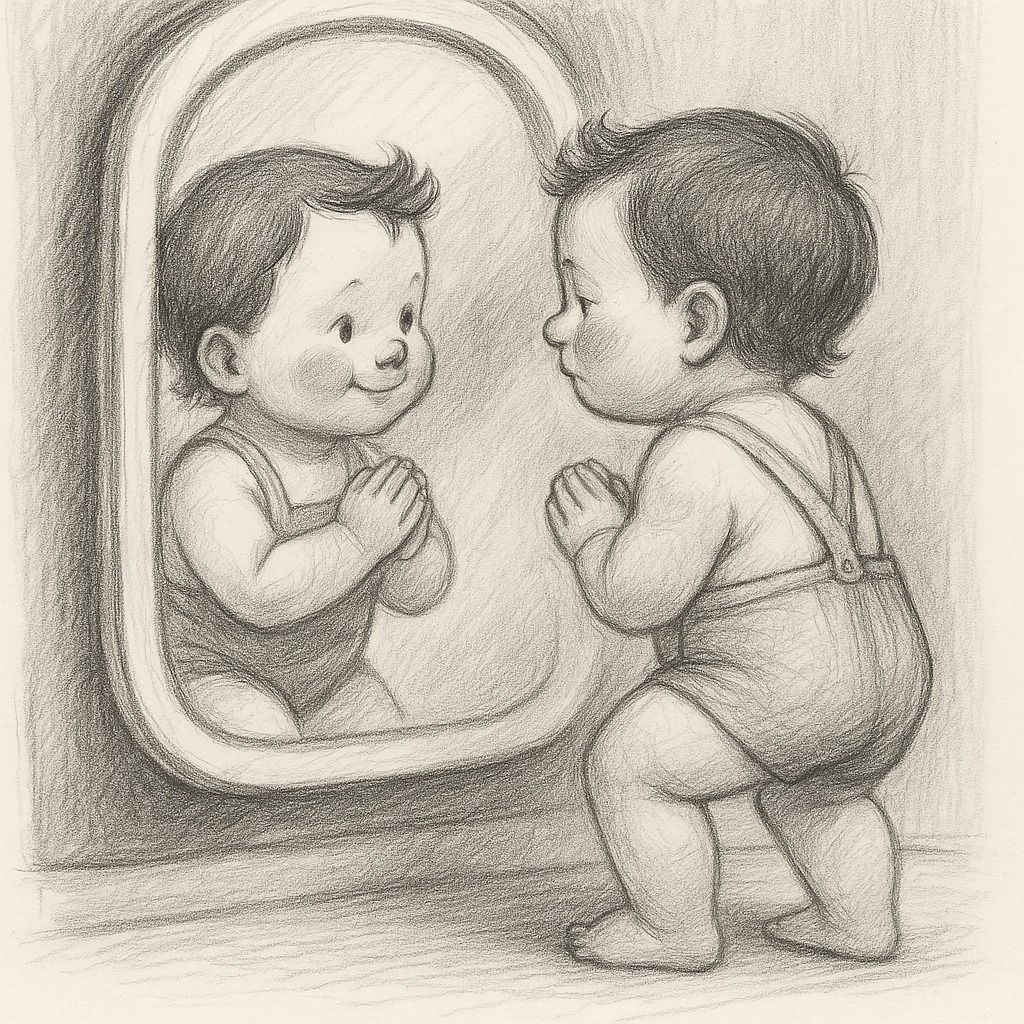
Jacques Lacan*: Ayna Evresi — Benliğin Yansıması
In Jacques Lacan's psychoanalytic theory, the 'mirror stage' describes the developmental period in which the individual recognizes themselves as a whole for the first time and begins to construct their sense of 'self.' This stage is not merely a psychological process, but also the foundation of the relationship the human being establishes with themselves and the world.
In the first months of life, the infant cannot experience physical wholeness; their arms and legs feel scattered and uncontrolled to them. However, when they see their own reflection in the mirror, they begin to perceive these parts as a whole. This 'illusion of wholeness' is the first seed of the 'self-image'.
According to Lacan, the human self is not an internal reality, but is constructed from the outside—that is, through a reflection. The child claims the image they see in the mirror: 'That is me.' But paradoxically, that image is not themselves; it is merely a reflection.
For this reason, Lacan views the 'mirror stage' as a moment of illusion and alienation. The individual finds their own self in an 'external' image and continues to seek the approval of this reflection throughout their life. In fact, the 'external construction of the self' in childhood explains, at least to some degree, our lifelong curiosity about how we appear in the eyes of others.
The mirror is not merely a glass surface—it is also the gaze of society and others. Even when we become adults, who we are is largely determined by this 'gaze.' The desire for approval, admiration, and acceptance; these are all extensions of the 'mirror stage' in adult life.
Başkasının bakışı olmadan kendini tanımlayamayan özne, sürekli olarak dış dünyadan gelen yansımalarla benliğini yeniden inşa eder. Bu nedenle, Lacan’a göre insan hiçbir zaman tam anlamıyla “tam” değildir — çünkü kendilik algısı hep bir başkasına bağlıdır. Yani aslında her insan başkalarının bakışıyla var olur” ve de “başkasının bakışına muhtaçtır”.
The mirror stage, while constructing the self on one hand, creates its fragility on the other. The individual becomes dependent on the gazes and judgments originating from the outside world. Praise inflates the perception of self; rejection destroys it. Therefore, Lacan’s subject is an incomplete being—constantly lacking, constantly searching. In truth, the identity we establish through reflection is, at the same time, an identity distorted by reflection.
In today's world, Lacan's 'mirror' is not merely an object; it is screens, social media profiles, photographs, and virtual identities. Every 'like' and every 'comment' we receive offers a new reflection—and the individual redefines themselves through these reflections, just as they did in childhood.
Modern man transforms into a subject fixated on his own image: a self that strives to 'look like himself,' but is, in reality, a prisoner of that image.
Lacan’s 'mirror stage' is not merely a moment belonging to childhood; it is a process that continues throughout life. Every relationship, every gaze, and every encounter in daily life is a new reflection. A human being’s attempt to understand themselves is—at its deepest level—an attempt to decipher the relationship they have established with these reflections.
Perhaps this is why Lacan’s subject can never fully be 'I'; because the subject always exists, at least partially, in the eyes of others.
*Jacques Marie Émile Lacan (1901–1981), Fransız psikiyatrist, psikanalist ve düşünürdür. Freud’un kuramlarını yeniden yorumlayarak 20. yüzyılın ikinci yarısında psikanalize felsefi, dilbilimsel ve yapısalcı bir yön kazandırmıştır.
References
- Evans, D. (2006). An introductory dictionary of Lacanian psychoanalysis. London, England: Routledge.
- Lacan, J. (1949/2010). The mirror stage as formative of the function of the I as revealed in psychoanalytic experience. In C. M. Lemert (Ed.), Social theory: The multicultural, global, and classic readings (pp. 343–344). Philadelphia, PA: Westview Press.
- Miller, P. (2002). Pure psychoanalysis, applied psychoanalysis and psychotherapy. Lacanian Ink, 20(4), 4–43.